


My creative journey began not with an ambition to become an artist, but with a need—to represent a life, my own. The work that emerged was a simple yet unsettling grid: 4,900 symbols arranged in 70 columns and 70 rows, each one marking a week in a human lifespan. Weeks already lived were marked as solid and unique; weeks to come faded gradually into transparency, weighted by the probability of survival drawn from mortality tables. Some symbols were colored, anchoring personal memories. It was at once clinical and intimate, algorithmic and emotional—a quiet confrontation with the passing of time. I didn’t set out to make art. I was trying to understand something. I still am.
As a professor random processes, I spend much of my life immersed in the mathematics of uncertainty. Randomness, probability, noise—these are not just abstract concepts to me, but the raw material of both my intellectual and creative practice. What began as a way to make these concepts tangible for students soon took on a life of its own. Representing randomness visually became an obsession, a form of play, and a means of exploration. It allowed me to embody in form what I knew in theory: that randomness is not chaos, but structure beyond our grasp; that it governs the world around us, and the world within.
A decisive moment came when I saw a work by Niele Toroni at the Museum of Modern Art in New York. A series of imprints—red squares, repeated with mechanical precision—resonated with me in a way that few things had before. The strength of the work lay not in narrative or symbolism, but in its formal clarity and conceptual force. It gave me permission to create without justification, to explore systems and constraints, and to allow repetition and variation to speak for themselves. Since then, I’ve embraced randomness not merely as a tool, but as a subject, a philosophy, and a way of seeing.
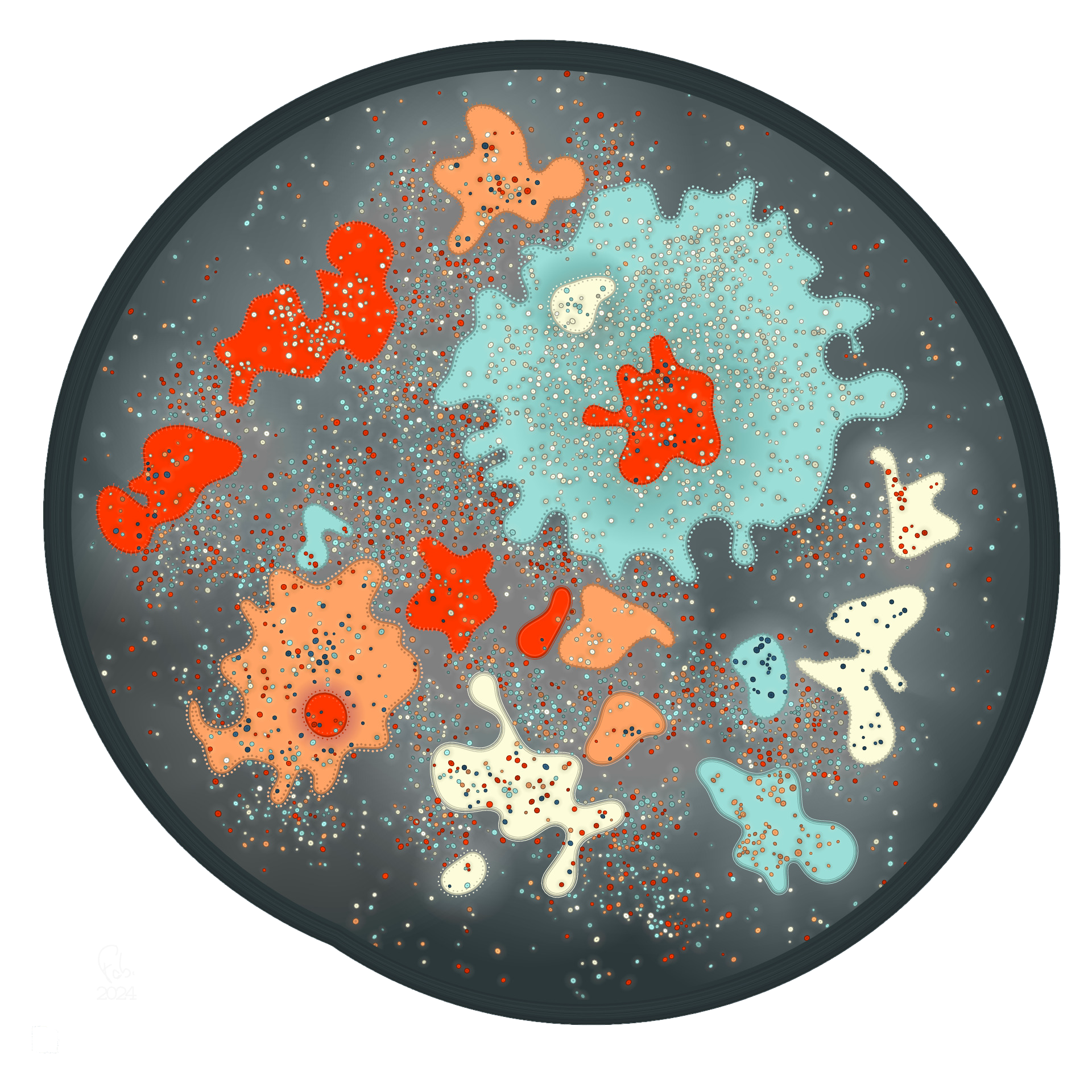
What I do is generative art. I write algorithms—structured sets of instructions—that define systems in which randomness can unfold. These algorithms are not creative in themselves; they are vessels, designed with care and constraint, that invite unpredictable outcomes. While the resulting images are generated by a computer, they are not produced by artificial intelligence. I don’t train models, I don’t replicate styles, I don’t delegate authorship. The machine is an instrument—precise, fast, and obedient—but the ideas, rules, and logic are entirely mine. The art emerges in the space between control and release, between logic and noise.
The role of randomness in each work varies. In some pieces, chance is used modestly, to color or disrupt a pattern; in others, it dominates completely, with outputs that even I, their creator, cannot predict or fully explain. This is not a flaw—it is the point. I am fascinated by the boundary between the knowable and the unknowable, the designed and the discovered. Randomness, properly framed, becomes a way of accessing something deeper, something beyond intent. It allows room for life to enter.
My work is also marked by recurring forms—especially circles. These imperfect, hand-like shapes recur not for symbolic reasons, but because they feel natural. Unlike rigid geometries, circles suggest continuity, openness, warmth. Nature offers few straight lines; it tends toward curves, growth, erosion. I follow that lead. The imperfection of these forms resists the cold perfection of digital space. They remind me — and hopefully the viewer — that what’s alive is never exact.
Underlying all my work is a kind of quiet resistance: against overcontrol, against the fetish of precision, against the idea that meaning must be declared. I believe that emotion can emerge from systems, that beauty can be born of constraint, and that randomness, far from being meaningless, is one of the deepest forces shaping our world. My pieces are, in a way, homages to noise—to the unpredictable, the statistical, the living.
I create not to explain, but to reveal. Not to master the random, but to coexist with it.
As a professor random processes, I spend much of my life immersed in the mathematics of uncertainty. Randomness, probability, noise—these are not just abstract concepts to me, but the raw material of both my intellectual and creative practice. What began as a way to make these concepts tangible for students soon took on a life of its own. Representing randomness visually became an obsession, a form of play, and a means of exploration. It allowed me to embody in form what I knew in theory: that randomness is not chaos, but structure beyond our grasp; that it governs the world around us, and the world within.
A decisive moment came when I saw a work by Niele Toroni at the Museum of Modern Art in New York. A series of imprints—red squares, repeated with mechanical precision—resonated with me in a way that few things had before. The strength of the work lay not in narrative or symbolism, but in its formal clarity and conceptual force. It gave me permission to create without justification, to explore systems and constraints, and to allow repetition and variation to speak for themselves. Since then, I’ve embraced randomness not merely as a tool, but as a subject, a philosophy, and a way of seeing.
What I do is generative art. I write algorithms—structured sets of instructions—that define systems in which randomness can unfold. These algorithms are not creative in themselves; they are vessels, designed with care and constraint, that invite unpredictable outcomes. While the resulting images are generated by a computer, they are not produced by artificial intelligence. I don’t train models, I don’t replicate styles, I don’t delegate authorship. The machine is an instrument—precise, fast, and obedient—but the ideas, rules, and logic are entirely mine. The art emerges in the space between control and release, between logic and noise.
The role of randomness in each work varies. In some pieces, chance is used modestly, to color or disrupt a pattern; in others, it dominates completely, with outputs that even I, their creator, cannot predict or fully explain. This is not a flaw—it is the point. I am fascinated by the boundary between the knowable and the unknowable, the designed and the discovered. Randomness, properly framed, becomes a way of accessing something deeper, something beyond intent. It allows room for life to enter.
My work is also marked by recurring forms—especially circles. These imperfect, hand-like shapes recur not for symbolic reasons, but because they feel natural. Unlike rigid geometries, circles suggest continuity, openness, warmth. Nature offers few straight lines; it tends toward curves, growth, erosion. I follow that lead. The imperfection of these forms resists the cold perfection of digital space. They remind me — and hopefully the viewer — that what’s alive is never exact.
Underlying all my work is a kind of quiet resistance: against overcontrol, against the fetish of precision, against the idea that meaning must be declared. I believe that emotion can emerge from systems, that beauty can be born of constraint, and that randomness, far from being meaningless, is one of the deepest forces shaping our world. My pieces are, in a way, homages to noise—to the unpredictable, the statistical, the living.
I create not to explain, but to reveal. Not to master the random, but to coexist with it.